
Ghana With Solar Power
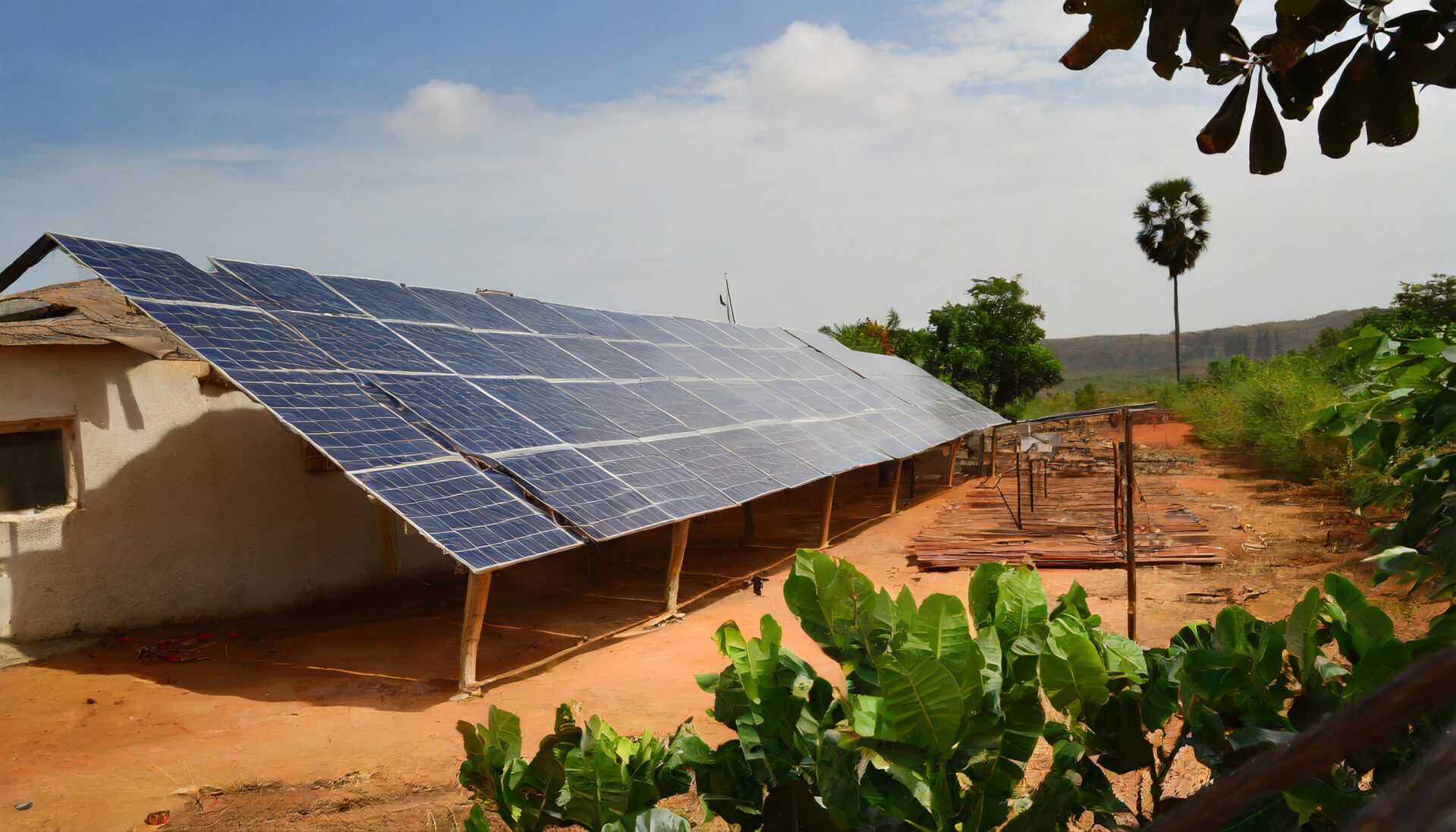
Ghana is a country located in west Africa and area of 238,000 km2 – approximately the same size as the UK with a population of approximately 31 million: This compares with only 5 million in 1950. Half of the country is savana grassland becoming drier as you proceed north towards the Sahara Desert. The other half is predominantly tropical rain forest although most of the forest has been removed and replaced with commercial and subsistence agriculture. The key crops are cocoa (Ghana is the worlds second largest producer) and oil palm but new commercial crops including pineapples and mango are now of growing importance.
There is a long coastline of 539 kms and 2/3rds of the population live within 150 kms of the coast including the capital Accra with 4 million people and Kumasi with 2 million. 60% of the population is now urban in towns of more than 5,000 while 40% remains rural.
There are two major ports at Tema near Accra and Takoradi in the west and a major port for cocoa and tropical timber. It has also become the major centre for the offshore oil and gas industry.
Ghana became independent from Britain in 1957 although its legislative council dates from the 1920’s and internal rule from 1952. It was the first country in Africa to become independent and today is one of the most democratic countries in Africa with frequent changes of government. The parliament is dominated by 2 political parties both of whom have controlled the parliament and presidency over the last 30 years.
Ghana is surrounded by the French speaking countries of Cote D’ Ivoire (west) , Togo (east) and Burkina Faso (north). All of the west African countries are in an economic grouping called Economic Community of West African States (ECOWAS) similar to the EU in Europe. However most of Ghana’s trade is with Europe, North America, China and India.
Electricity was first introduced to Ghana in 1917 by the Ghana Railways in Takoradi and later generators were introduced in key towns across the country including Accra, Kumasi, Cape Coast, Winneba, Koforidua and Tamale so by the 1930’s most towns had electricity. Indeed Accra had the largest generator in Africa. They were all powered by imported diesel and so after the second world war there were plans to utilise the power from the massive Volta river which crosses the whole country. It became a symbolic policy of the first president of Ghana, Dr Kwame Nkrumah to bring cheap electricity to the whole country and he succeeded with the building of the Aksombo Dam completed in 1965. A further smaller dam at Kpong was built 1977-82 and the Bui dam on the upper Volta was completed in 2013.
At the beginning there was a massive excess of power and the Kaiser Aluminium company built an alumina plant in Tema to consume the excess. However during the 1980’s and ‘90’s the demand for power from a growing population forced the government to change the terms of the agreement with Kaiser as the country needed more capacity. In the 2,000’s and afterwards climate change reduced the flow of the Volta and its tributaries and new power stations were built that used imported crude oil and gas. Of the total power consumed in 2019 only 35% now comes from hydro and much of that is exported to other west Africa countries as part of a power pool arrangement.
With consumption growing at 7% per annum and hydro in decline this led to load shedding in 2014 to 2015 and severe effects on the economy. ‘Dumsor’ as it was known in Ghana forced the government to turn to alternative sources of power and independent power producers (IPP) came ‘to the rescue’.
Within 5 years Ghana had switched from power shortage to power surplus buying from Independent Power producers (IPP). The government signed contracts that favoured the IPP companies but not Ghana. By 2019 Ghana incurred massive ‘legacy debts’ amounting to $500 million per annum as the IPP’s were generating power for which there was no demand but the agreements were based on a ‘take or pay’ basis. Capacity had increased to 5,083 mW but peak load was only 2,700 mW leaving a surplus capacity of 2,200 to be paid for on basis of take or pay. There was also a surplus of excess gas purchase ranging from $550 million to $850 million per annum and 2 unwanted LNG contracts. The issues that arose from this policy include
1)lack of flexibility – capacity to cover needs without paying for excess generation
2)Payment un IS dollars while customers pay in cedis
3) suffocates competition especially renewables which is tragic given the benefits of nature in Ghana
4) Inflated and fixed prices despite falling prices over the past year particularly after the pandemic
5) No currency risk on the part of the IPP’s
6) Potential for corruption given the large amounts of capital needed to fund the contract including power leasing and the purchase of fuel
7) A failure in negotiations to negotiate an ‘economic’ contract rather than simply solving an immediate political problem
Most energy is supplied to the urban areas where demand is the greatest and the location of most large corporate units who have the most needs for energy.
By contrast only 50% of rural areas have access to grid power. This is far better than most African countries but it does mean that the potential for economic development is significantly reduced in the rural areas. A large percentage of the people is unable to benefit from electricity and subsequently unable to contribute to economic growth and their own standard of living.
The grid system is expensive to maintain and any extension of it to the villages especially in the north is expensive to build and the customers at the end of the line are not substantial and their extreme poverty means government has to subsidise the power they need.
Renewable Energy
The growth of renewables over the past year including the Governments own plans have slowed down because of the commitment to the IPP’s. The only utility solar farm remains the development near Winneba.
The Government says renewables are the way to
- Ensure security of supply and
- Securing access to power in every village and every farm in the country
The renewable targets cover hydro, solar and wind and can be summarized as follows;
- 150-300mw of small and medium hydro. Large scale hydro has now been abandoned because of cost, climate change and the time it takes to execute projects.
- 2 million solar lanterns
- 30,000 home solar installations but no net metering
- 50-150mW of utility solar
- 20 mW of biomass and wind.
Offgridinstaller of Britain and Ghana can fill another gap in the Ghana renewable market – OFFGRID SOLAR. Whatever the future power situation, Offgrid allows the owner to be independent of the grid and to control his own ‘energy destiny’. Storage batteries have fallen dramatically in price and now have a life span of 15-20 years. Equally the panels continue to be cheaper, have a higher output and a lifespan of 40 years. If offgrid is combined with energy saving, every enterprise , every organisation and every home can go offgrid.
For more details contact the Ghana area office in Nsawam tel. +050 302 3112 (whats app) email: spence@offgridinstaller.com
Area manager is Spence Adu Banafo. Contact Spence and he can arrange a free offgrid quotation.
Find out more about our off-Grid solar services for Africa
Our brands
Off-Grid Installer are proud to bring you the best solar products, sourced only from the world's leading manufacturers.


Interested in getting started?
Get in touch with one of our Off-Grid experts now.
Contact Us
Contact us today to speak with our experienced and knowledgeable consultants — we would love to hear from you!
Address
Trinity Suite, Office 4, Hawkesyard Hall, Rugeley, Staffordshire WS15 1PU