
Off grid power in Madeira
Madeira is a series of 4 islands lying off the NW coast of Africa….

Madeira is a small archipelago of 5 islands but most live on the main island of Madeira. The other islands are Porto Santos, and Desertas composed of Bugio, Desertas Grande and Chuo.
Madeira and the other islands off the NW Atlantic coast are 520 kms from Morocco and 1,000 kms off the European mainland. The islands were discovered by the Portuguese in 1410 and by 1420 were settled under the monarch Prince Henry the Navigator. Despite being known by the Romans and visited by Iberian fishermen Madeira is frequently referred to as the first island in the Age of Discovery: Christopher Columbus lived on Madeira for a time. The islands have been Portuguese from the 15th Century and are still an integral part of Portugal and the European Union. However the islands have internal self government with a separate parliament and local government functions..
During the Napleonic wars at the beginning of the 19th Century the islands were occupied by the British and close relations have been retained with the UK. The islands are exotic but culturally, economically and politically European.
After the islands were occupied by the Portuguese they became the centre for sugar cultivation financed by Genoese merchants and this persisted until the 17th Century when competition from Brazil led to a rapid decline and replacement by wine production. Madeira is a fortified, dessert wine with established sales in northern Europe especially the UK.
Many Madeirans emigrated to America and Canada in the 19th Century and there is even a community of 4,000 on the island of Jersey.
The islands have a population of 289,000 but most – 262,000, live on the main island while another 6,000 live on Porto Santos. Porto Santos has its own airport and flights to Portugal. It is just a 15 minute flight from the main airport at Funchal. The Desertas Islands are nature reserves and no human visitors are allowed.
The Savage Islands , 280 KMs to the South East are also uninhabited except for one family and scientists and wardens operating a nature reserve.
On the main island,
Funchal, the capital; has a population of 112,000 or 40% of the total population. It has the main port, airport and all the principal hotels and leisure areas. Tourism is by far the most important industry accounting for 20% of GDP and 1.6 million year round visitors. Funchal is the ‘cruise capital of the world’ with most transatlantic cruise ships stopping at either Madeira or the Azores. There are wonderful walks across the island and the natural habitat is classed as a UNESCO ‘world heritage site.
Much of the population are immigrants from Europe and Latin America. The biggest group is Britons who account for 14% of all immigrants compared with 7% Germans and 12% from Brazil.
The port of Funchal also has an extensive Free Trade Zone used by the cruise companies to replenish their stocks including drinks, food and catering products. But its also designed to attract service and research companies to come to this attractive environment. Tax free status is possible for all investors and individuals prepared to establish a presence in Madeira.
GDP is $4,607 million euros with per capita of $18,096.
Power is provided by EEM (Empresa Electoridad di Madeira). They have a grid that covers the island but no links with Porto Santos. The mountainous nature of the island creates all sorts of problems. Increasing demand combined with managing the grid and transmission as well as the pumped storage.. Hundreds of years ago they built ‘levadas’ or ditches and tunnels taking water from the wetter to drier parts of the island’. This system is still used and adapted for pumped irrigation which also allows the production of hydroelectric power(HEP) from stored water. Although 70%% of power is generated from imported fossil fuels the other 30% is provided by HEP and a little over 1% by solar energy. Another 30 mW of HEP was coming on stream in 2020 with the aim of increasing renewables to 50%.
Currently total installed power on Madeira is 290 mW with peak demand of 150mW. Portos Santos has a separate power installation of 4 mW including
1 mW of wind.
Solar energy too has enormous potential with a warm subtropical climate and 228 sunny days per year. This typical Medierranean climate is characterised by sunny summers and wet winters.
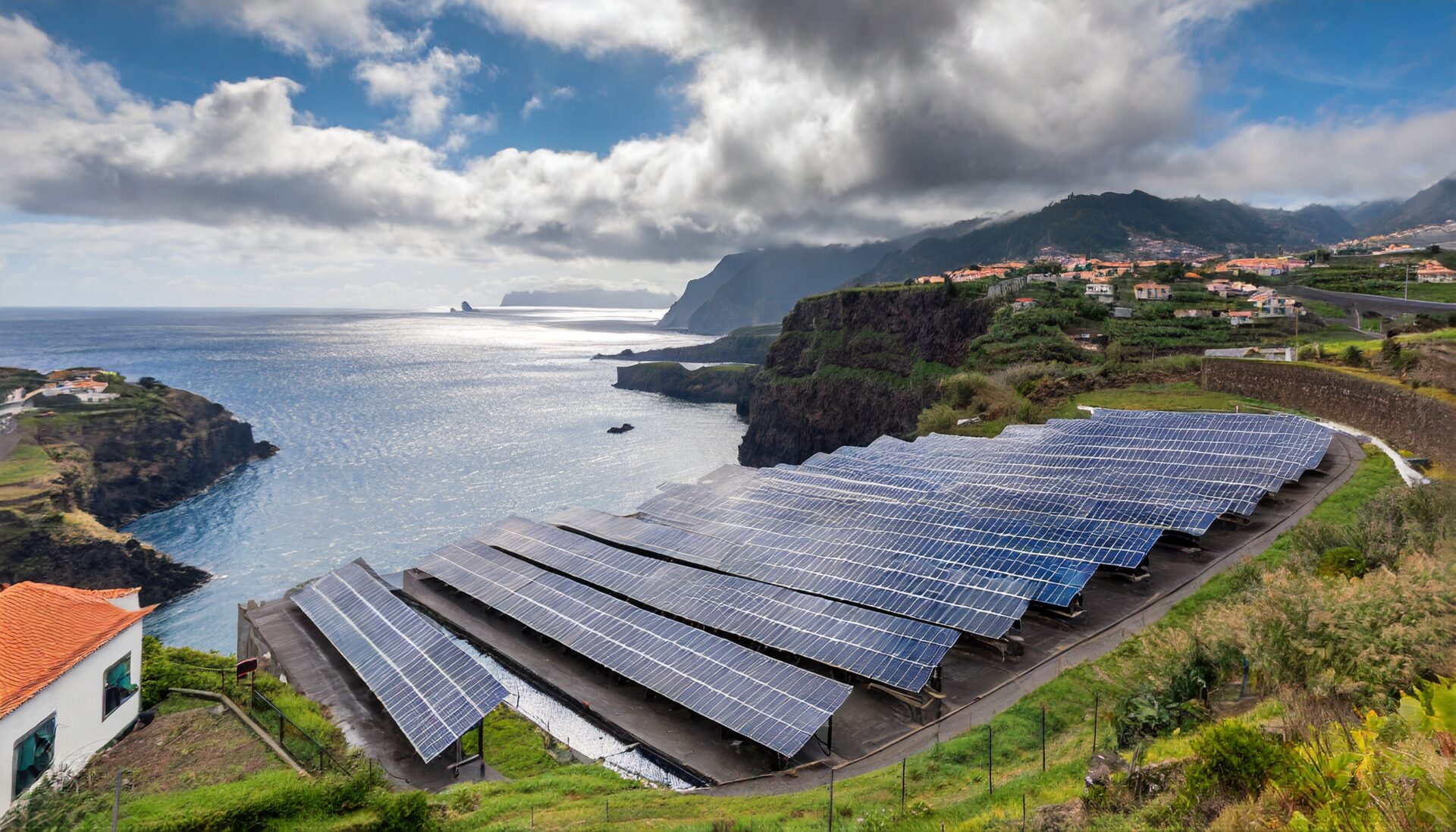
A larger solar installation on Madeira
As in mainland Portugal there was a net metering system in operation whereby the power company purchased the generated power and sold it back to the consumer making the whole investment uneconomic or lengthening the payback period. In 2009 power was purchased at 11 euro cents per kWhr and sold back at 6.5 eurocents. By 2015 the purchase price had deteriorated to
2 euro cents per kWhr.and solar installations came to a standstill .Consumers of solar power were unable to disconnect from the grid because of EEM’s monopoly position.. In 2016 a new regulation came in which allowed consumers to go off grid and store surplus power. The adoption of solar has been a real benefit to the economy and the environment. There have been savings of 22,000 tons of CO2 and 5 million euros less on imported fuel.
The southern side of the island has the best output for solar and so most installations have been in Calheta, Funchal and Porto do Sul. Typical systems vary between 4 and 8kW installed.
There has also been a high solar take up on the island of Porto Santos which is dependent on diesel generators. There are 19 installed solar systems all working well but with the potential for many more.
As an ideal location for solar energy, Off grid installer can supply and fit any size of solar system with high quality lithium ion battery storage which can generate and store power year round. The systems can be fitted in existing buildings or in stand alone 20 foot containers. Container systems are ideal for warehouses, hotels, restaurants and resort developments. Off grid installer can also add micro and macro networks to connect a multiple of buildings with a continuous electrical supply including vineyards and processing facilities.
Off grid installer is a British company with experience in Britain and the Mediterranean.
Our brands
Off-Grid Installer are proud to bring you the best solar products, sourced only from the world's leading manufacturers.


Interested in getting started?
Get in touch with one of our Off-Grid experts now.
Contact Us
Contact us today to speak with our experienced and knowledgeable consultants — we would love to hear from you!
Address
Trinity Suite, Office 4, Hawkesyard Hall, Rugeley, Staffordshire WS15 1PU