
South Africa — A renewable revolution and rapid economic growth for everyone
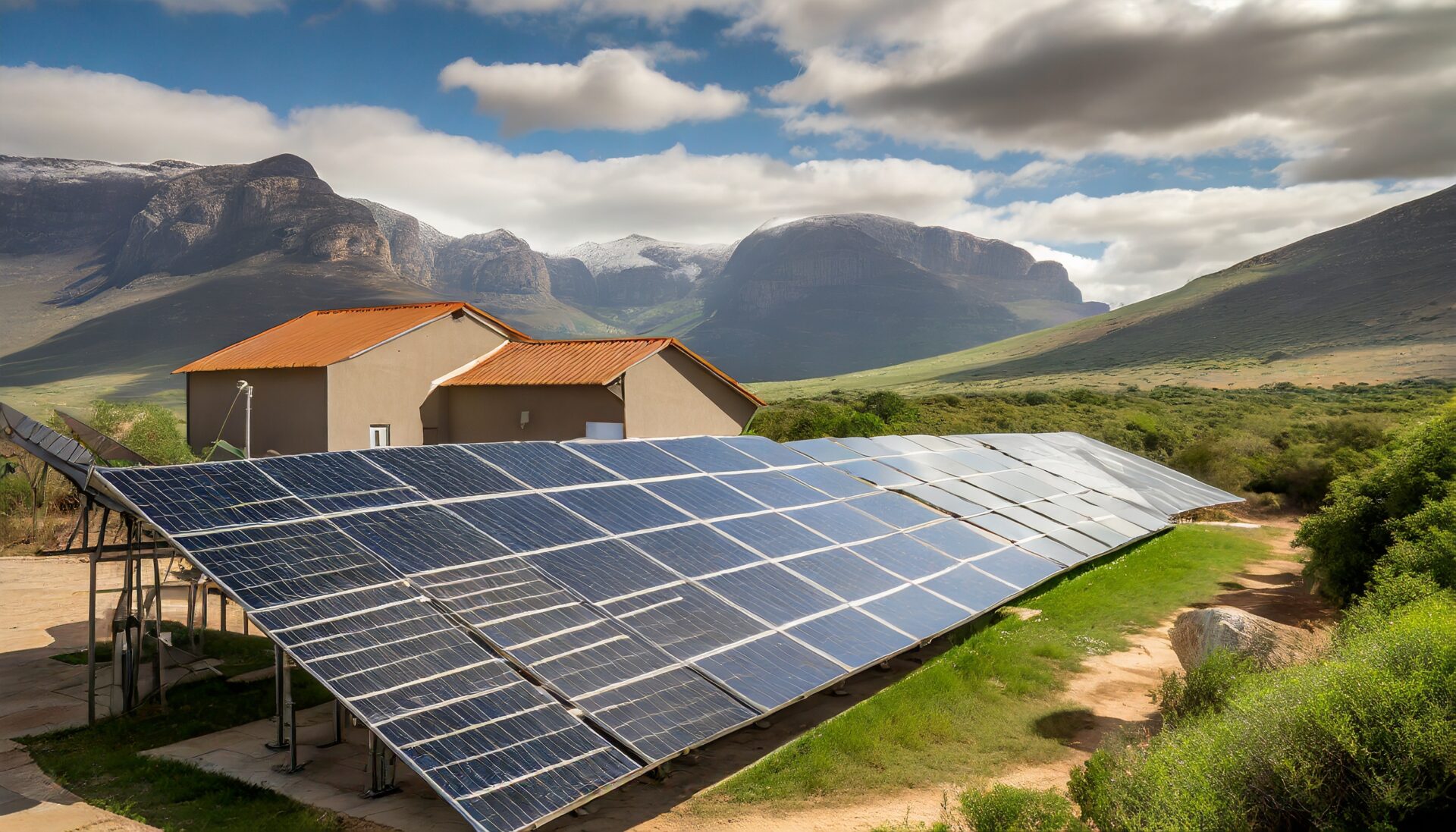
Located on the southern tip of Africa, South Africa is the most advanced and most industrialised countries. With a population of 59 million the country is one of Africa’s biggest with 1,221,037 km2.
The land scape vary from the deserts of the Kalahari to the evergreen vegetation of the western Cape and the sub tropical lushness of Kwazulu Natal.
The GDP PPP is $813 billion and South Africa is a member of the G20 and is a very much a middle income country playing a significant part in African policymaking and security.
South Africa is a heavily urbanized country at a rate of 66.4% in 2018 and an urbanization rate of 1.97% per annum over the last 5 years. More than 20 million people live in the top 5 urban areas including Johannesburg and Cape Town. Literacy rate is 94% while school attendance is 13-14 years. GDP is $813 billion (PPP) and per capita of $13,865.
However there is enormous inequality between the richest and poorest. A quarter of the population lives on less than $1.25 per day. Also HDI has fallen since 1995 so no improvement for most people which extends to quality of life, land ownership, housing, education and healthcare. These disparities tend to be racial and are a result of the country’s past history with whites being richer than the blacks. The whites live a first would life while most blacks live a third world existence although not as bad as most African countries. There is of course since the end of Apartheid the emergence of a black middle class and it’s a group that’s growing fast. Also the Asian population is now largely middle class but too many people are in urban shanty towns and rural poverty.
The energy structure in South Africa reflects the economic inequalities and ambiguities of this important country. The history and structure of the grid is similar to Europe and bears little resemblance to any country in Africa.
The first electricity dates from 1860 when it was used by the telegraph office in Cape Town. Town systems emerged in the 1890’s for streetlights in Cape Town and Kimberley which were the first offgrid systems in South Africa. Over time other town based systems emerged in South Africa towns particularly those closely connected with the rapidly growing mining industry at Kimberley and Johannesburg. Indeed it was not until 1923 that Eskom was formed as a monopoly supplier of electricity. Like countries in Europe electricity was generated in coal fired power stations and then distributed by a grid system around this very large country. Coal reserves like in Europe were not in the areas of major population and so the power had to reach Cape Town as well as Johannesburg and Durban.
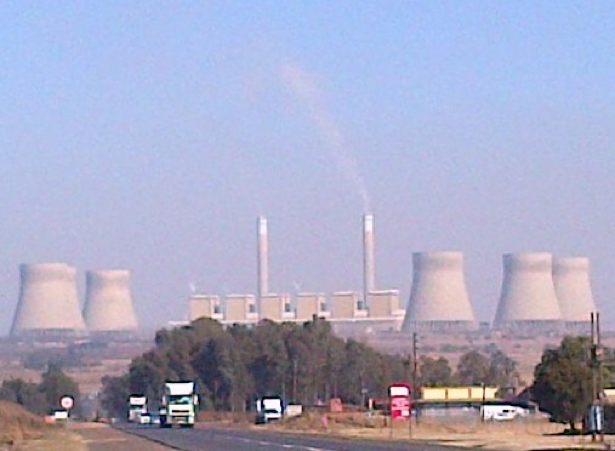
South Africa also has a culture of mining based on its history and a country rich in valuable raw materials including gold, platinum and diamonds. The coal companies had the political power and influence and use it and so Eskom built its power stations adjacent to open cast coal mines. The first power stations were opened near Cape Town and in the Rand but nowadays almost all are in the northern province of Mpumalanga close to the industrial areas in the Rand but a long way from other population centres like Cape Town (2,250 km). The two biggest stations are Duvha (3,600 MW) and Kendall (4,800 MW) but two new stations both dependent on coal are being built at Medupi and Kusile. Started in 2007 they are still not complete but part of Medupi came on stream in 2019. They will be the largest thermal stations in the world.
Power Breakdown in South Africa
| Type | Capacity (MW) |
| Coal | 40,036 |
| Gas turbine | 3,449 |
| Hydro | 3,573 |
| Wind | 2,096 |
| Nuclear | 1,860 |
| Solar PV | 1,479 |
| Solar CSP | 400 |
| Landfill gas | 7.5 |
| Imported hydro | 1,500 |
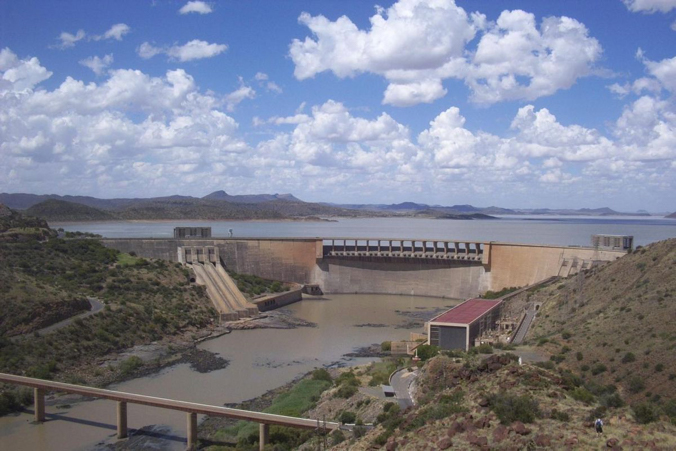
Most of the grid was built in the 1960s and ’70s as South Africa started to grow rapidly. In the same period several large power stations were built in the coalfields raising generation capacity from 4,000 MW to 40,000 MW. At the same time the country was covered with an integrated 400 kv power line transmission system. Over the last 40 years South Africa has also expanded into hydro electric power from dams in Lesotho and the Drakensburg mountains. They then financed a dam in Mozambique at Cabora Bassa and in recent years a second on the Zambezi at Mpanda Nkuwa which cost $2 billion. Increasingly South Africa sees more of their demand being satisfied by large schemes in southern and even central Africa. They are helping (with World Bank) the financing of the INGA 3 dam in DRC in return for 2,500 MW of the 4,500 MW of that facility. Similarly through the Southern Africa Power Pool, NEPAD and Southern African Development Council (SADC) they are hoping to secure as much extra power as possible. But their neighbours too are growing and far more rapidly than South Africa so in coming years they will need more of their own power power.
South Africa also has Africas only nuclear power station at Koeberg near Cape Town using the Atlantic for their water supply. However power maintenance is also a problem. Its provides 5% of the 1,860 MW which is approximately 5% of power output. They plan to expand to 9,600 MW when nuclear would be 20% of South Africas power capacity. South Africa is under pressure to cut its co2 emissions resulting from the burning of coal in thermal power stations. But nuclear is costly and there are cheaper sources of power. South Africa is now the 4 largest user of renewable power including HEP, nuclear, wind and solar.
Power Provision Comparisons kWh per capita per year
| World Average | 2,730 |
| OECD | 8,012 |
| Africa Average | 561 |
| South Africa | 4,532 |
| Namibia | 1,628 |
| Zimbabwe | 1,022 |
| Nigeria | 120 |
Total electricity production in South Africa 54,309 MW (91% thermal 8.8% renewables).
Since 2007 there has been extensive load shedding made worse by the commitment to supply neighbouring countries. Maintenance of the thermal plants is also a major problem because of the need to replace plant, poor maintenance, but also the burning of sub standard coal. Much of the best coal is exported to China and India through the worlds biggest coal port at Richards Bay in Kwazulu-Natal.
The customer base has a similar profile to Europe but Eskom remains a monopoly unlike Europe where there now many private power companies providing competition. Eskom have encouraged new generators especially in renewable energy but they can only sell their output to Eskom.
But demand for power continues to rise inexorably with an emphasis on supplying more power to rural areas and the poorer part of the urban population(the majority)using the same grid business model which doesn’t work when applied supplying the poor at a low cost or no cost at all. It’s a broken model and anew one is needed.
Eskom is responsible for 50% of Africas output of electricity and it sells the power cheaply — 5 c per kWh to commercial users and 11 to residential customers. Low prices are a problem as the utility needs to increase its rates to decrease debt and expand generation.
South Africa has a poor credit so capital costs are high. In the 1990’s there was an attempt to privatise but that failed and in 2018 plans were made to split the come up into generation, transmission and distribution but the company is technically insolvent and supported by government bail outs.
There is an alternative for South Africa and that is the application of renewable energy. The country already has more solar and wind than any other country in Africa. See the insolation map illustrating the large areas in the NW part of the country which are very dry and suitable for generating solar energy. But the whole country is suitable for a whole range of solar installations far superior to most of Europe.

The first two solar parks at Jasper (96 MW) and Lesedi (75 MW) near Kimberley in the Northern Cape, were developed by Solar Reserve. Investors include Rand Merchant Bank and Google ($12 miullion). Jasper produces 180,000 MWh of per year for 80,000 homes using 325,000 panels. After completion only needs 50 employees for maintenance and security compared with the thousands needed in a thermal power station. Meanwhile the new thermal station started in 2007 in Mpumalanga was still 4 years behind schedule when Jasper came on stream in 2014. Jasper also saves 145,000 tonnes of CO2 emissions.

Solar parks have expanded massively over the last 5 years. De Aar 1 and 2 total 85 and 90 MW and has been built by Solar Capital Kathu started in 2016 and completed in 2019 total 100 MW so far the largest in South Africa and indeed whole of Africa. It cost $81 million, powers 179,000 homes and account for 6 million tonnes of CO2 emissions.
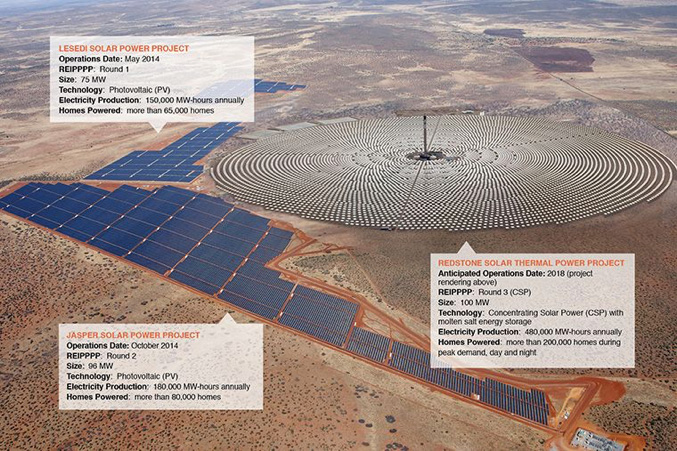
Sonnevix have built 75 MW and plan more in South Africa and elsewhere in Africa. Their local contractor was JUWC. The lastet solar park is Kalkbult totalling 75 MW.
All the solar parks have been built in the Northern Cape. All feed the massive South African grid. They bring jobs and overall power growth and a reduction in CO2 emissions but not local developments and jobs which come with offgrid solar.
The solar parks are part of the South African target of 8,400 MW of solar by 2030 under the scheme known as Renewable Energy Industrial Power Producer Procurement Program (REIPPPP). All the power is purchased by Eskom but 16% of the revenue from sales contributes towards a programme of bringing power and education to the rural areas.
Apart from large scale solar designed to supplement the grid there is also a smaller domestic solar programme financed by NEPAD (National Electrification Programme) which aims to bring power to rural households a long way from the nearest grid point. The plan is to install 300,000 systems and 22,000 have been installed so far. They provide power for basic services to ensure that everyone has some access to electricity. The government pay 80% up front and the contractors obtain the balance and maintenance costs from weekly instalments paid either by the customer or the government. There are several contractors such as Solar Vision who specialise in these types of installation. There must also be potential in this scheme for large installations for rural businesses who are far from the grid.
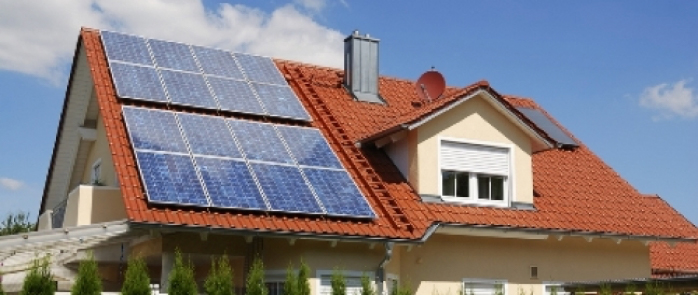
The full potential for renewables has not been realised in South Africa. Large solar, wind and even nuclear are helping reduce carbon emissions but they follow a very ‘old’ and discredited model of large power stations or solar parks to feed the grid. Such models supply power to the richer part of society not to the poor or businesses located in small towns and the rural areas.
The International Solar Energy Society (ISES) state that if smaller models like mini grids are introduced they will help create new jobs because of cheap and more important available energy. The ISES estimate 62 jobs per gigawatt hour of power produced. There is tremendous unemployment amongst the young especially in marginal areas and government lacks the will to rectify the situation and explains the large numbers existing on less than a dollar a day.
Susbsidies are needed and pay as you go meters to pay for the systems which provide readily available power. Until organisations and/or provide guarantees financial institutions will not finance small scale renewable projects.
Bur for solar, South Africa is an exciting environment and with the cutbacks in nuclear development because of cost and the need to reduce carbon emissions there will be plenty of opportunities for off grid solar.
Bibliography
International Solar Energy Society
International Rivers Organisation, Pretoria
Eskom website and history
SADC (Southern African Development Community)
Powertime Co.ZA (solar parks)
Ministry of Energy, South Africa
Cambridge Centre for alternative Finance (CCAF)
Offgrid Solar Market Trends 2020
GNESD (UNEP), Copenhagen, Denmark
Find out more about our off-Grid solar services for Africa
Our brands
Off-Grid Installer are proud to bring you the best solar products, sourced only from the world's leading manufacturers.


Interested in getting started?
Get in touch with one of our Off-Grid experts now.
Contact Us
Contact us today to speak with our experienced and knowledgeable consultants — we would love to hear from you!
Address
Trinity Suite, Office 4, Hawkesyard Hall, Rugeley, Staffordshire WS15 1PU