
Sun, Water And Life

Solar energy systems/power plants do not produce air pollution, water pollution, or greenhouse gases. Using solar energy can have a positive, indirect effect on the environment when solar energy replaces or reduces the use of other energy sources that have larger effects on the environment.
Water is the blood supply of the world, without it nothing lives, nothing grows and the landscape is barren. Solar energy is the other vital ingredient in ensuring water can be moved to where its needed in agriculture and providing clean water to the population. No one in the 21st Century should be without clean water and farmland needs continuous, controlled moisture. Its possible to bring solar and maximise the capture of water for drinking, agriculture and other economic activities.
In sub Saharan Africa 40% of the population – more than 300 milllion have no access to clean water. On average a person needs 20 litres per day to provide basic needs of drinking and hygiene. 7.5 litres is regarded as the minimum. In Africa only 44% of the urban population and 24% of the rural has access to an adequate water supply. However for every dollar invested in water and sanitation provided gives an economic return of between $3 and $34 so Offgridinstaller container units will soon starting seeing a return.
In the rural areas people can walk as far as 6 kms to collect water and it consumes up to 60% of the day. Most of the collection and carrying is done by woman aided by children(see picture below). It makes it difficult for children to receive an education and for women to engage in any productive economic activity.
In Africa, protein energy malnutrition (PEM) is high and results in diseases including kwashiorkor particularly in young children and other PEM problems associated with lack of clean water.
Disputes over scarce water can lead to conflict which can be local or national as in South Sudan, Mali, Nigeria and between all countries in the Nile basin. Same applies to the Zambezi, Volta and Niger rivers where downstream countries are afraid of abstraction by upstream countries for water supply such as reservoirs and hydro electric power. Sometimes countries partner as with the Cabora Bassa dam in Mozambique on the Limpopo. Built and financed by the South Africans, most of the power goes to the industrial heartlands of South Africa but Mozambique benefits from direct revenue and has a share of the power and water.
In Ghana a huge hydro electric scheme was built on the Volta in the 1960’s and added to in the 1970’s. The political ideal was to make Ghana self sufficient in power for 100 years but that didn’t happen and by the 2000’s Ghana was again short of power and a third dam was built upstream at Bui. It was started in 2009 and completed in 2013 at a cost of $622 million. The size of the dam is 400mW with output of 980gWhrs. Long droughts and climate change have altered outcomes not foreseen when first proposed in 1973. Imagine how many solar containerised units could have been supplied within a year at a fraction of this cost. The whole of northern Ghana could have switched to solar leaving the hydro electric power for the south and big cities. The contribution of hydro is now down to 35% of total power supplies and even lower in the dry season.
Local journalist Mike Anane called it an environmental disaster. The power generated by hydro stations is certainly renewable but has all sorts of side effects. In the case of Bui it flooded 20% of the Bui National park; threatened the habitat of rare animals, forced the resettlement of 1,200 people which still hasn’t happened and forced the Government of Ghana to pledge 30,000 tonnes of cocoa in an escrow account. Also by adding to grid capacity it could be said that it is simply encouraging people (including the 1200 not resettled) to move to large urban centres like Accra and Kumasi. By comparison solar container units from Offgridinstaller can bring power to local communities at a fraction of the cost, discourage drift to the towns and grow local economies. At a minimum a solar container installation at Bui could have provided the power necessary for invigorating the local economy including agriculture and tourism in the national park.
Power supplies can now be decentralised with a move away from national grid distribution. Does anyone seriously believe that Nigeria with 3 gW(cf UK with 85 gW) of installed power can ever have a grid to serve 170 million people and a rapidly growing economy. Even Ghana with less than 3 gW will soon have a population of 35 million with 50% in urban areas and the rest still in the rural areas. Extending the grid in the rural areas is incredibly expensive and uneconomic. By comparison Offgridinstaller container units can be installed in every village and small town pumping water to where it is needed and providing local electrical needs.
Alternative power sources like the grid and generators are extremely vulnerable to break downs, lack of fuel, lack of spare parts and excess demand in the grid leading to power cuts. Even hydro electric power – a source of renewable energy is susceptible to dry seasons where there is insufficient water to drive the turbines. In Africa this is far common now because of climate change
People need Solar power to pump water and operate equipment which can clean dirty water and suspect water supplies in villages and towns at an incredibly low cost. Using a water tank or reservoir filled by pumps driven by Offgridinstaller containerised units can improve yields and regulate the use of precious water resources. The recirculation of water and filtration of dirty water can be achieved with power from containerised solar power units.

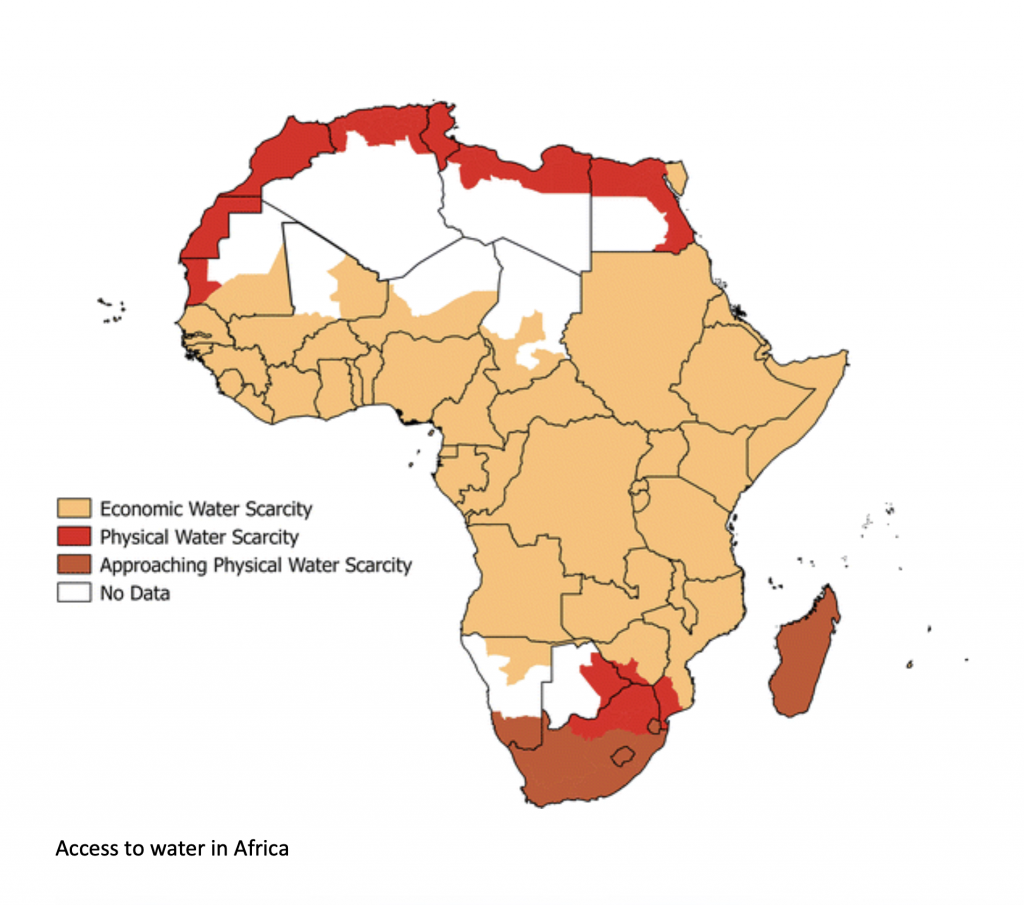
Access to water in Africa
Water is a major factor in maintaining public health. Using to clean up the water supply and take away water infected with cholera and other deadly diseases. Power is need at water pumping stations and at sludge plants handling water borne sewage. At this time of corona virus infections and the effect on Europe (around 50,000 deaths so far (April 6th 2020)) half of all hospital admissions throughout the world are the result of waterborne infections. Every year 3.4 million people die from water infections including 3,000 children every day(1.5 million per year) and 1 in 3 of the population has no access to sanitation

These problems can occur everywhere in Africa and solar power can be secured anywhere in Africa.
Most African countries have sustainable development goals (SDG) most of which involve water;
- Effective sanitation and water preservation systems including innovative pump systems using solar as a power source.
- Decrease waste in irrigation so as to extend the area irrigated and ensure that plants and trees have the right amount of water to guarantee higher yield even during an extended drought. This involves improved trickle technology and low cost solar power
- Use of Ecosan toilets that eliminate the use of water but waste still needs to be processed and disposed of with the risk of e coli contamination.
- Establish protected reservoirs to limit evaporation and ensure there is sufficient water for trickle irrigation.
There is a fundamental relationship between energy, water and life. No life is possible without water and energy. Solar energy is absorbed by plants and trees but the water cycle is only possible if all elements are present in sufficient quantity. Clearly much of Africa is desert or semi desert and water supply is stressed therefore needs careful conservation. If the suns energy is collected by solar panels and converted into electrical energy, water supply can be moved and conserved to help promoted its fundamental tasks including human consumption and use in agriculture and commercial applications including industry.
Offgridinstaller can provide any size of container based system up to 1 mW in either a 20 foot or 40 foot containers so energy can be used locally satisfying local needs.
Find out more about our off-Grid solar services for Africa
Our brands
Off-Grid Installer are proud to bring you the best solar products, sourced only from the world's leading manufacturers.


Interested in getting started?
Get in touch with one of our Off-Grid experts now.
Contact Us
Contact us today to speak with our experienced and knowledgeable consultants — we would love to hear from you!
Address
Trinity Suite, Office 4, Hawkesyard Hall, Rugeley, Staffordshire WS15 1PU